

Hiring the wrong SEO consultant in Singapore can waste six to twelve months of budget while your competitors take market share. Hiring the right one can transform organic search from cost centre to primary growth channel. The difference is substantial, and the hiring process deserves more rigour than most businesses apply.
This guide is the practical buyer’s framework — a structured approach to evaluating SEO consultants in Singapore, the specific questions that surface fit, and the common hiring mistakes to avoid.
Framework Overview
Choosing an SEO consultant effectively involves five stages:
- Define what you actually need — clarity on objectives before evaluation
- Shortlist candidates — identify 3-5 genuine prospects, not just top-of-mind brands
- Initial screening — 30-minute calls to evaluate basic fit
- Deep evaluation — proposals, reference checks, cultural assessment
- Final selection and engagement structure — right consultant, right model, right terms
Most businesses skip stages 1 and 4 and wonder why outcomes disappoint.
Stage 1 — Define What You Actually Need
Before evaluating any consultant, clarify:

Your Commercial Objectives
What are you actually trying to achieve with SEO over the next 12 months?
- Lead generation — increase qualified inbound enquiries from organic search
- Revenue attribution — demonstrable organic-driven revenue for specific business lines
- Market position — category authority in your vertical
- Competitive defence — maintain rankings against aggressive competitors
- Channel diversification — reduce dependence on paid acquisition
Clarity on objectives shapes everything downstream. “Improve our SEO” is too vague to produce good decisions.
Your Current State
Honest assessment of where you are:
- What’s your current organic traffic volume and trend?
- What commercial keywords do you currently rank for?
- What’s your domain authority position vs competitors?
- What’s your existing content inventory?
- What’s your technical foundation like?
Your Resources
- Monthly SEO budget range
- Content production capacity (in-house, freelance, or needed from consultant)
- Engineering capacity for technical implementation
- Stakeholder availability for strategic conversations
Your Constraints
- Time horizon for results
- Regulatory or compliance considerations
- Brand voice or content limitations
- Previous bad experiences to avoid repeating
This foundation makes evaluation substantially more effective than vague shopping.
Stage 2 — Shortlisting Candidates
Generate a shortlist of 5-7 prospective consultants using:
Your professional network. Ask other marketing leaders or business owners who they’d recommend. Personal recommendations beat anonymous ratings.
Industry recognition. Consultants with speaking credentials (Ahrefs Conference, SMX, BrightonSEO), published thought leadership, or significant industry presence signal demonstrated expertise.
Case study depth. Consultants who publish specific case studies with measurable outcomes signal confidence in their track record.
LinkedIn research. Check employment history, client testimonials, and recent activity. Consistent substantive engagement indicates active practitioner vs dormant profile.
Published content quality. Review their blog, LinkedIn posts, podcast appearances. Quality content correlates with quality consulting.
Referrals from declined engagements. Consultants with integrity refer businesses they can’t help. Ask “if you couldn’t take our engagement, who would you recommend?” — the answers often identify strong alternatives.
Skip pure “best SEO consultants in Singapore” listicles — most are pay-to-play. See Best SEO Agency in Singapore for why these rankings are unreliable.
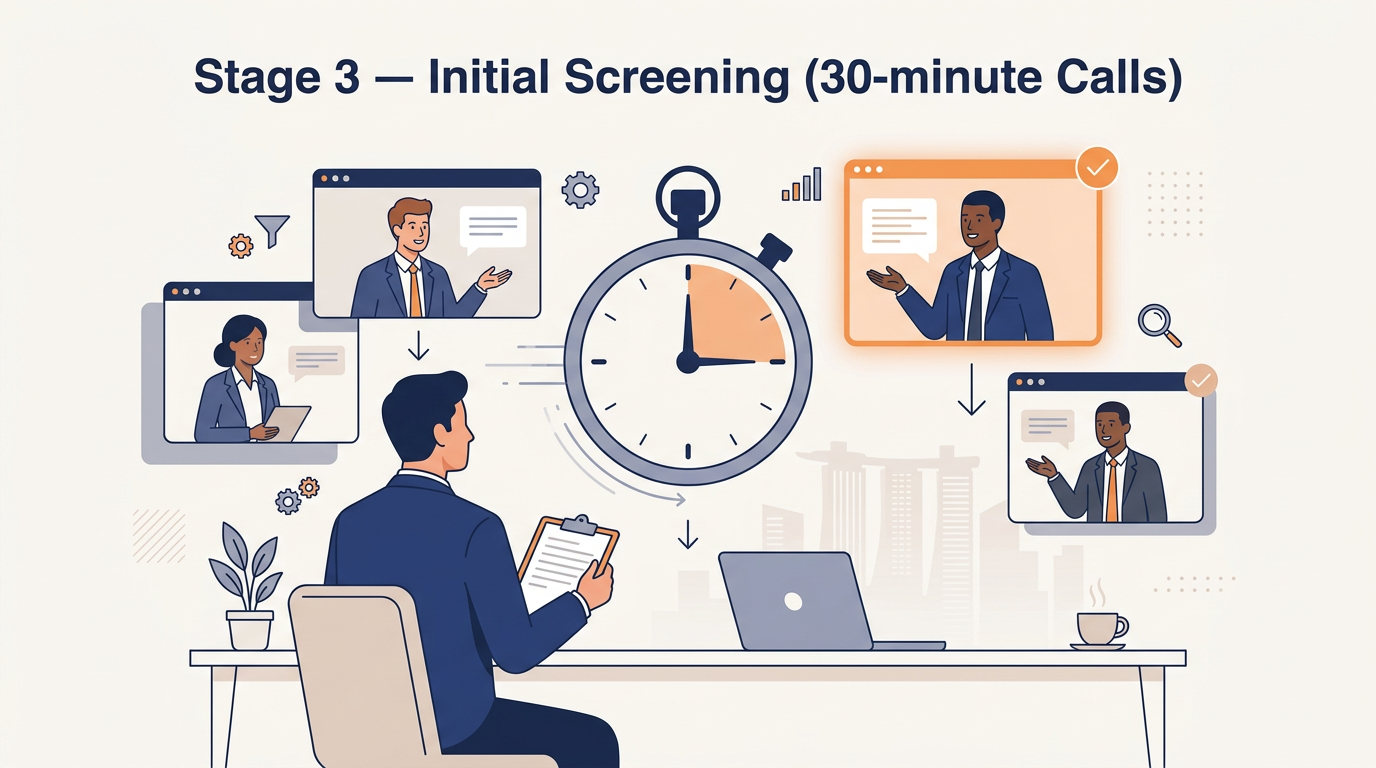
Stage 3 — Initial Screening (30-minute Calls)
Shortlist to 3-5 after initial research. Book 30-minute calls with each.
What a Good Screening Call Looks Like
First 5-10 minutes: Consultant asks about your business, objectives, current state. If they start pitching services immediately without substantive discovery, that’s a signal.
Next 15 minutes: Substantive discussion of your situation. Good consultants ask probing questions, offer early observations, reference relevant experience.
Last 5-10 minutes: Initial honest assessment — what they might help with, what’s outside their fit, rough scope direction.
Questions to Ask in Screening Calls
“Based on what I’ve described, what’s your initial reaction?”
Good consultants have opinions early. They share relevant observations, identify obvious opportunities, or flag concerns. Weak consultants stay non-committal and push for paid discovery.
“What would you want to understand better before proposing anything?”
Reveals their diagnostic process. Real consultants want specific information types. Weak ones are ready to propose without understanding.
“Have you worked with businesses like mine?”
Specifics matter. “Yes, we work with many SaaS companies” is weak. “We’ve worked with three Series A B2B SaaS companies expanding across APAC — here are the patterns we saw” is strong.
“What would you push back on from what I’ve described?”
Strong consultants offer genuine intellectual engagement. Agreement without pushback in a first conversation = sales mode, not consulting mode.
“What wouldn’t you want to work on with us, and why?”
Real consultants have clear decline criteria. Generic “we can help with anything” signals sales over substance.
Stage 4 — Deep Evaluation
Shortlist to 2-3 after screening. Each gets:
A Substantive Proposal Request
Give each candidate the same detailed brief. Specifics they should address:
- Their read on your current situation
- Recommended engagement structure (retainer, project, hourly)
- Prioritised first 90-day roadmap
- Expected outcomes over 12 months with rationale
- Pricing with specific deliverables
- Team who’d work with you (for consultancies with multiple people)
Evaluate proposals against:
– Strategic depth — do they demonstrate genuine understanding of your business?
– Specificity — concrete recommendations vs vague capability claims
– Honest scope — realistic commitments vs overpromising
– Pricing clarity — clear fee structure vs vague “starting from” ranges
Reference Checks
Ask for 2-3 references and actually call them. Good questions:
- What was the specific situation when you engaged them?
- What did they do particularly well?
- What could they have done better?
- What outcome did you achieve?
- Would you engage them again?
Pay attention to spontaneous specifics. “They’re great” without details = reference management. Substantive stories with specific wins and acknowledged limitations = genuine reference.
Cultural Fit Assessment
SEO engagements are relationships lasting 6-24+ months. Cultural fit matters. Consider:
- Do you enjoy talking with them?
- Do they communicate in ways your team can absorb?
- Are their working styles compatible with yours?
- Do they push back when appropriate?
- Do they handle tension professionally?
Technical capability matters, but so does how they engage with you as people.
Stage 5 — Final Selection and Engagement Structure

Choosing Between Finalists
If 2-3 candidates all seem strong, consider:
- Specialisation match — which has the deepest experience in your specific situation?
- Availability and bandwidth — who has the capacity to give you proper attention?
- Engagement model fit — who structures work in a way that matches your needs?
- Strategic challenge — who pushed back on your assumptions most substantively?
- Reference quality — whose references were most specific and credible?
Engagement Structure Decisions
For the chosen consultant:
- Retainer vs project vs hybrid — match to your specific needs
- Contract length — 6-12 months typical for retainers, with termination clauses
- Payment structure — monthly invoicing for retainers, milestones for projects
- Scope clarity — written documentation of specific deliverables
- Termination terms — 30-60 day notice typical
See SEO Retainer vs Project-Based vs Hourly for detailed engagement model guidance.
Common Hiring Mistakes
Patterns we see repeatedly:
Choosing based on price alone. Cheapest isn’t best (or even usually good). But expensive doesn’t automatically mean strong either. Evaluate price against scope and expected outcomes.
Hiring based on brand recognition. Well-known agencies aren’t automatically the right fit for your business. Boutique consultants often produce better outcomes for specific situations.
Skipping reference checks. Perhaps the highest-ROI step; perhaps the most commonly skipped.
Overweighting flashy proposals. Beautiful PowerPoints don’t correlate with quality execution. Evaluate substance over production value.
Missing cultural fit signals. Skills matter, but working relationship matters equally over 12+ months.
Rushing the decision. SEO engagement is meaningful commitment. Taking 3-4 weeks for proper evaluation prevents months of regret.
Not clarifying termination terms. Lock-in without exit paths is asymmetric risk. Insist on reasonable notice periods.
What Good Looks Like After Hiring
After engaging a good SEO consultant, expect within the first 60 days:

- Substantive strategic alignment conversation with clear objectives
- Comprehensive audit with specific findings and recommendations
- Prioritised roadmap you can defend to your board
- Monthly reporting that ties to commercial metrics
- Direct access to the senior consultant (not just account managers)
- Pushback on decisions they disagree with
If after 60 days you’re not seeing these signs, something is wrong — address it early rather than hoping it improves.
FAQ — How to Choose an SEO Consultant Singapore
How long should I take to choose an SEO consultant?
2-4 weeks for proper evaluation. Rushing produces regret; dragging creates opportunity cost. Three to five weeks is a reasonable range.
How many consultants should I interview?
3-5 for shortlist, 2-3 for deep evaluation. Fewer risks settling; more creates decision fatigue without proportional insight.
What’s the most important factor in choosing an SEO consultant?
Fit with your specific business situation. Not “best consultant” — right consultant for you.
Should I pay for discovery calls?
Most legitimate consultants offer free 30-minute initial consultations. Paid discovery makes sense for deep diagnostic work before proposal, not basic screening.
How much should an SEO consultant in Singapore cost?
Senior consultants: SGD 4,000-15,000/month retainers, SGD 350-450/hour consulting. See our complete SEO pricing guide.
What if I can’t decide between 2 strong candidates?
Consider pilot engagements — start with a discrete project or short retainer to evaluate fit before long commitment. Either candidate being strong, fit usually reveals itself quickly.
Should I choose a SG-based consultant or remote?
SG-based consultants understand local market dynamics better. Remote can work for businesses where market specifics matter less. Both models produce good outcomes for appropriate fits.
Start the Conversation
If you’re evaluating SEO consultants in Singapore and want to explore whether Sovereign SEO is the right fit — or would benefit from an honest second opinion on candidates you’re considering — reach out.
Book a free 30-minute consultation or email [email protected].
Related Reading
- SEO Expert Singapore — identifying genuine expertise
- SEO Consultant vs SEO Agency — decision framework
- Best SEO Agency in Singapore — agency selection
- Best SEO Company in Singapore — company evaluation
- How Much Does SEO Cost in Singapore? — pricing context
- Meet Eugene Leow — lead consultant profile