Skyscanner is a global travel search engine with deep organic visibility across most major markets. When they brought us in, the brief was specific: re-optimise the meta titles, meta descriptions, and H1 tags on two of their highest-intent template page types — Flights to {city/airport} and Routes — across ten markets that needed sharper localisation.
This was on-page SEO at template scale, not a one-off page rewrite. A single template change at Skyscanner’s scale propagates to thousands of URLs simultaneously, which is what makes this kind of work both high-leverage and high-stakes — the right pattern compounds across the index, the wrong pattern damages thousands of pages at once. The work fed into a wider international SEO programme run alongside specialists in other regions, with shared learnings flowing back into the central optimisation playbook.
Brief
Skyscanner needed market-specific optimisation for ten markets where their existing templates were either translated literally or under-optimised for local search behaviour:
- Israel
- Singapore
- Belgium
- Greece
- Saudi Arabia
- New Zealand
- Switzerland
- Taiwan
- Mexico
- Turkey
The page types in scope:
- Flights to {city/airport} — high-volume transactional pages targeting destination intent.
- Routes — pairwise origin-destination pages capturing comparison and planning queries.
The objective was page 1 rank 1 visibility on the priority queries in each market, with measurable lift in organic traffic to the optimised templates.
Approach
Three phases, run in parallel where the markets allowed it:
1. Keyword research per market. Local-language and Romanised variants for destinations, airline brand modifiers, and intent qualifiers (cheap, direct, return, business). Search-volume signals were cross-checked with click-through patterns to filter out high-volume but low-intent queries.
2. Competitor SERP analysis. Reviewed the top three organic competitors per market — typically a mix of OTAs, airline sites, and local aggregators — for meta title patterns, description hooks, and H1 framings that were performing. Patterns differed sharply by market: some SERPs rewarded price-led descriptions, others favoured trust signals or carrier-name modifiers. The Israel and Saudi Arabia results in particular looked nothing like the Western European patterns we used as a baseline.
3. SEO copy per template. Drafted meta titles, descriptions, and H1 variants that combined Skyscanner’s brand voice with the local query patterns. Output went into Skyscanner’s experimentation framework for staged rollout, not direct push to production. Working inside a controlled experimentation pipeline meant every recommendation needed to stand on its own as a testable hypothesis with a clear baseline metric — usually CTR from impression data plus position movement on the priority query set.
The work was completed in March 2023. Specific keyword sets, before/after rankings, and the experimentation results sit under NDA until March 2027.
Result
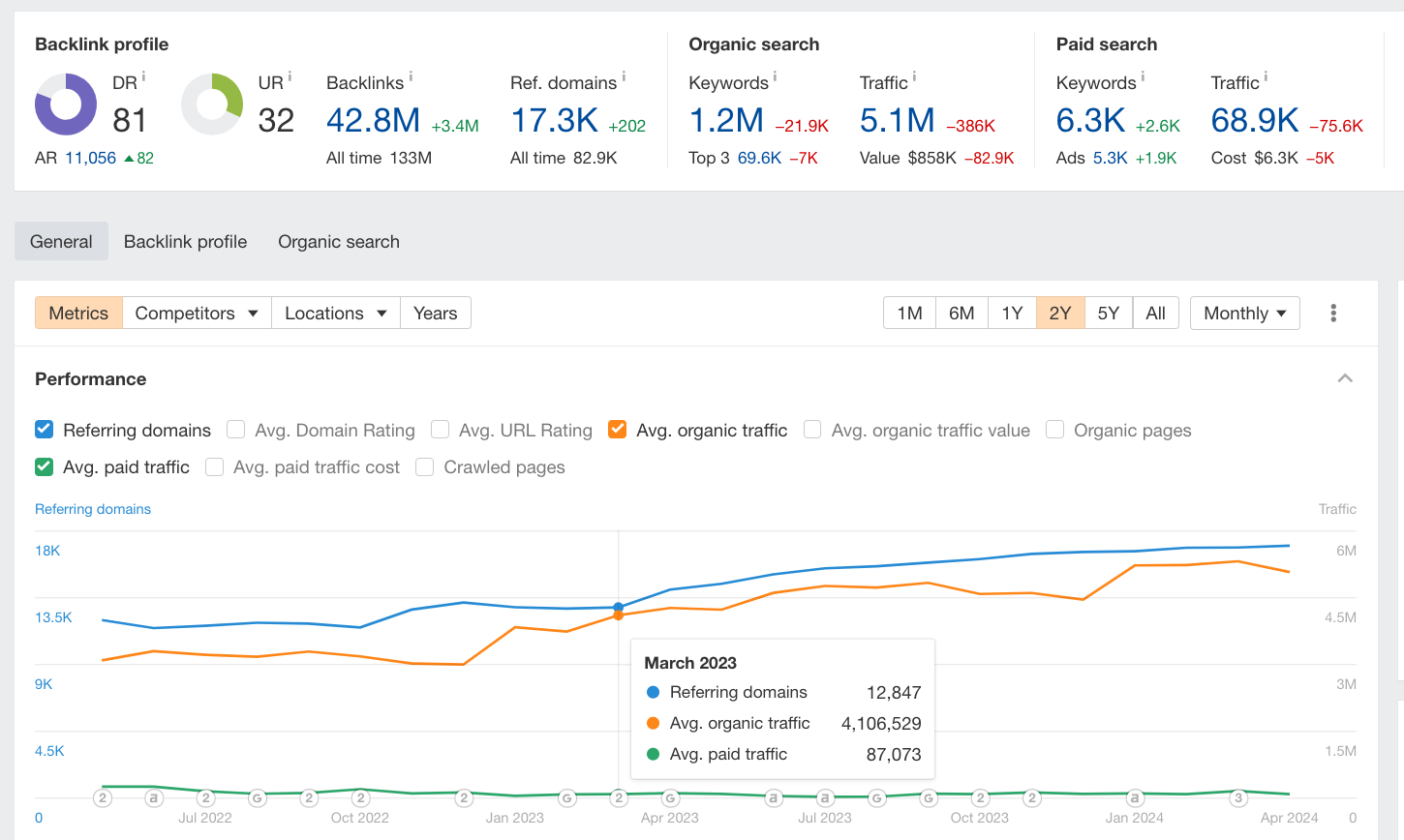
By April 2024 — twelve months after the optimisations were live — Skyscanner’s overall organic traffic had grown approximately 25% year on year, taking total organic visitors from around 4 million to over 5 million per month according to Ahrefs.
A 25% lift on a base of 4 million is not attributable to any single workstream, and Skyscanner runs many parallel SEO and product initiatives in any given quarter. The work documented here was one input among several. What we can say is that the optimised templates were performing in line with the test hypothesis at handover, and the patterns we identified per market were folded into the broader template strategy.
For context, sustained year-on-year organic growth in the high single digits is healthy for a mature travel platform at this scale. A 25% blended lift puts Skyscanner well above that benchmark for the period in question.
Why this kind of work matters
International SEO at platform scale is rarely about clever copy. It is about getting the template-level fundamentals right across enough markets to compound at the brand level — meta that matches local search intent, descriptions that earn click-through against entrenched local competitors, and H1s that align with the page content rather than the brand template default.
The most common failure mode for global brands operating in APAC and emerging markets is to treat localisation as a translation problem. It isn’t. Search behaviour, query construction, and what users expect to see in a SERP listing differ enough between Singapore and Saudi Arabia, or between Greece and New Zealand, that a directly translated template will under-perform a properly localised one by a wide margin — even when the underlying product is identical. Skyscanner had already invested in translation; what was missing was the SEO-led layer on top of it.
If your business operates across multiple markets and your localised pages are still using direct translations of the English template, there is usually meaningful traffic sitting in that gap. We work on this kind of programme regularly, both for global brands with mature international footprints and for SG-headquartered businesses expanding into new APAC markets. Get in touch if you would like to discuss what is possible for your markets.