
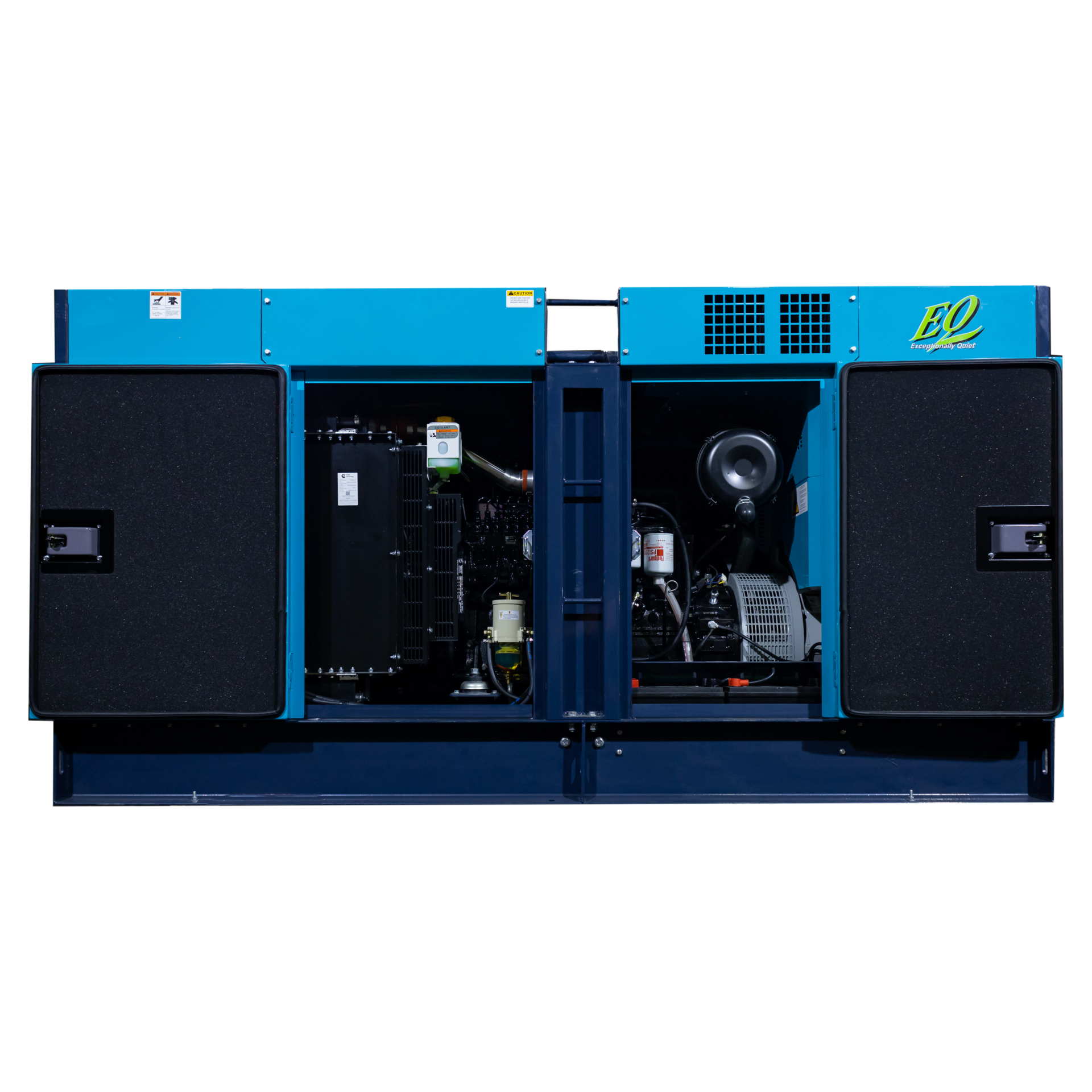
McWel is a Singapore-based industrial manufacturer, established in 2006, producing generators, welders, water pumps, and compressors. Their machinery powers villages, construction sites, factories, hotels, and commercial buildings across the ASEAN region. The product engineering was solid; the marketing collateral did not match. McWel needed a master product catalogue that could be put in front of engineers, project managers, and procurement decision-makers without underselling the technical depth of the product line.
The brief came in via JPN Industrial, with the catalogue commissioned as a 20-page printed and digital piece.
Brief
Industrial B2B copy fails in two predictable ways. Either it is too generic — full of words like innovative, reliable, cutting-edge that mean nothing to a specifier comparing technical sheets — or it is too dry, reading like a translated spec sheet that buries the actual buying triggers under undifferentiated technical detail.
The catalogue needed to do something narrower than either: present McWel’s product line in language that engineers and procurement leads would recognise as credible, while still serving non-technical decision-makers who would see the catalogue at the executive sign-off stage.
Concretely:
- Cover the four main product categories (generators, welders, water pumps, compressors) with consistent depth and structure.
- Surface the genuinely differentiated features — accessible maintenance frames, low-noise compliant engines, dual voltage systems, optional automatic transfer switches and parallel operation — without buying-guide bloat.
- Make the after-sales offering (parts, repair, maintenance contracts, extended warranties, rentals, training, load testing) visible enough that procurement teams could factor it into total-cost-of-ownership comparisons.
- Maintain a tone that read as confident and technically grounded, not promotional.
Approach
This was a three-party collaboration: our copy, VoidFocal Photography on the industrial photography, and Conquest Creatives on the layout, typography, and visual system. Roles stayed clean — each party handled their own discipline without trying to drive the others.
Discovery and scoping. Initial sessions with McWel to understand the buying journey for each product category, the specific buying triggers that mattered most by audience type, and the after-sales differentiation that procurement teams actually weighed in vendor comparisons.
Photography planning. Worked with VoidFocal on a shot list that balanced hero product images, operational context shots, and detail captures of the maintenance access points that engineers care about. The photography needed to do work that copy could not — making the product feel substantial and well-built without saying so explicitly.
Copy development. Each product family handled with the same template: positioning paragraph, technical specifications, optional enhancements, after-sales coverage, and use-case context. Specifications presented as readable structured copy, not dumped tables. Cross-references between products handled cleanly so a generator buyer could see the related compressor or welder line without page-flipping.
Iteration. Three rounds of review with McWel covering both copy and overall flow. Conquest Creatives took the final copy into the design layout, with light copy adjustments where line breaks or column widths required tightening.
Final delivery. Print-ready PDF and softcopy for digital distribution.
Result
The deliverable was the 20-page master catalogue itself — a working sales and procurement piece that McWel could put in front of any audience in the ASEAN region with confidence.
Specific machinery covered in the catalogue included the McWel MGC156S generator, the M630 welder, and the VT8 Lightning Tower (in standard and extended configurations), with consistent treatment across the broader product range.
We do not have post-distribution sales attribution data — that was outside the scope of the engagement and would not have been a fair attribution exercise in any case. What we can say is that the catalogue replaced a previous version that the McWel team was visibly less confident putting in front of customers, and that the new piece is now part of standard sales process across the four product lines.
Why this kind of work matters
B2B copywriting in the industrial category sits at an awkward intersection. The audience is technical enough that fluffy marketing copy actively damages credibility, but the deliverable is usually procured by marketing teams who are not themselves technical. The copywriter’s job is to produce something that reads correctly to the engineer evaluating the product without losing the procurement and executive readers who also need to feel confident signing off.
It is the kind of work that benefits enormously from disciplined collaboration between writer, photographer, and designer. Each discipline can carry weight that the others cannot — copy for technical credibility, photography for substantiveness, design for the implicit signal of corporate seriousness.
If you have a product line that has outgrown its current marketing collateral, get in touch. We work on this kind of B2B catalogue and product-marketing brief regularly.