Merchynt is a B2B SaaS company specialising in Google Business Profile management and local SEO services for small to medium-sized businesses, with their main market in the United States. Their two flagship products are Paige, an automated Google Business Profile management tool, and RoboReply, AI-driven software for responding to Google reviews at scale. Both are positioned at agencies running local SEO for chains and franchises, with white-label options for resellers.
When we started the engagement, the products were genuinely strong. The organic visibility was nowhere close to matching the underlying capability.
Brief
The brief was on-page SEO. Specifically, to take a SaaS site whose technical foundation was already healthy and rebuild the on-page layer so that it would compete for the commercial queries that mattered for their buyer journey.
The buyer Merchynt was selling to was sophisticated. Marketing agencies running local SEO for client portfolios. Multi-location brands looking to outsource Google Business Profile work. Franchise operators needing review management at scale. These buyers do not respond to generic SEO software messaging — they search for category-specific tools using category-specific language: GBP management service, white label reputation management, local SEO outsourcing, AI review management.
The on-page work needed to:
- Rebuild service and product pages around those commercial query clusters.
- Surface the white-label angle prominently for the agency audience without burying it for the direct-to-merchant audience.
- Make the differentiation between Paige (GBP management) and RoboReply (review response) clear enough that buyers landed on the right product page from search rather than bouncing.
- Strengthen content depth across the blog so the site had topical authority signals at the category level, not just at individual landing pages.
The project concluded in January 2022.
Approach
Keyword and intent mapping. Every commercial query Merchynt could plausibly compete for was mapped to a target page. Where pages did not exist, they were briefed and built. Where pages existed but targeted the wrong query intent, they were rebuilt. Long-tail informational queries seeded the blog roadmap.
On-page rebuilding. Service and product pages restructured around clear H1/H2 hierarchies with query-anchored copy, comparison sections, use-case framing, and FAQ blocks targeting the secondary questions buyers actually ask before purchase. Meta titles and descriptions written for both ranking and click-through, with attention to character limits and SERP truncation behaviour.
Content layer. Blog topics built around the questions that GBP managers, agencies, and franchise marketers actually search for. Tutorial content for Merchynt’s tools to capture branded support traffic. Industry pieces on local search trends and GBP best practices to build topical authority signals.
Internal linking and site architecture. Reorganised internal linking so authority flowed from high-traffic blog pages through to the commercial service pages. Anchor text discipline applied consistently so the linking signals were aligned with the target queries.
Result
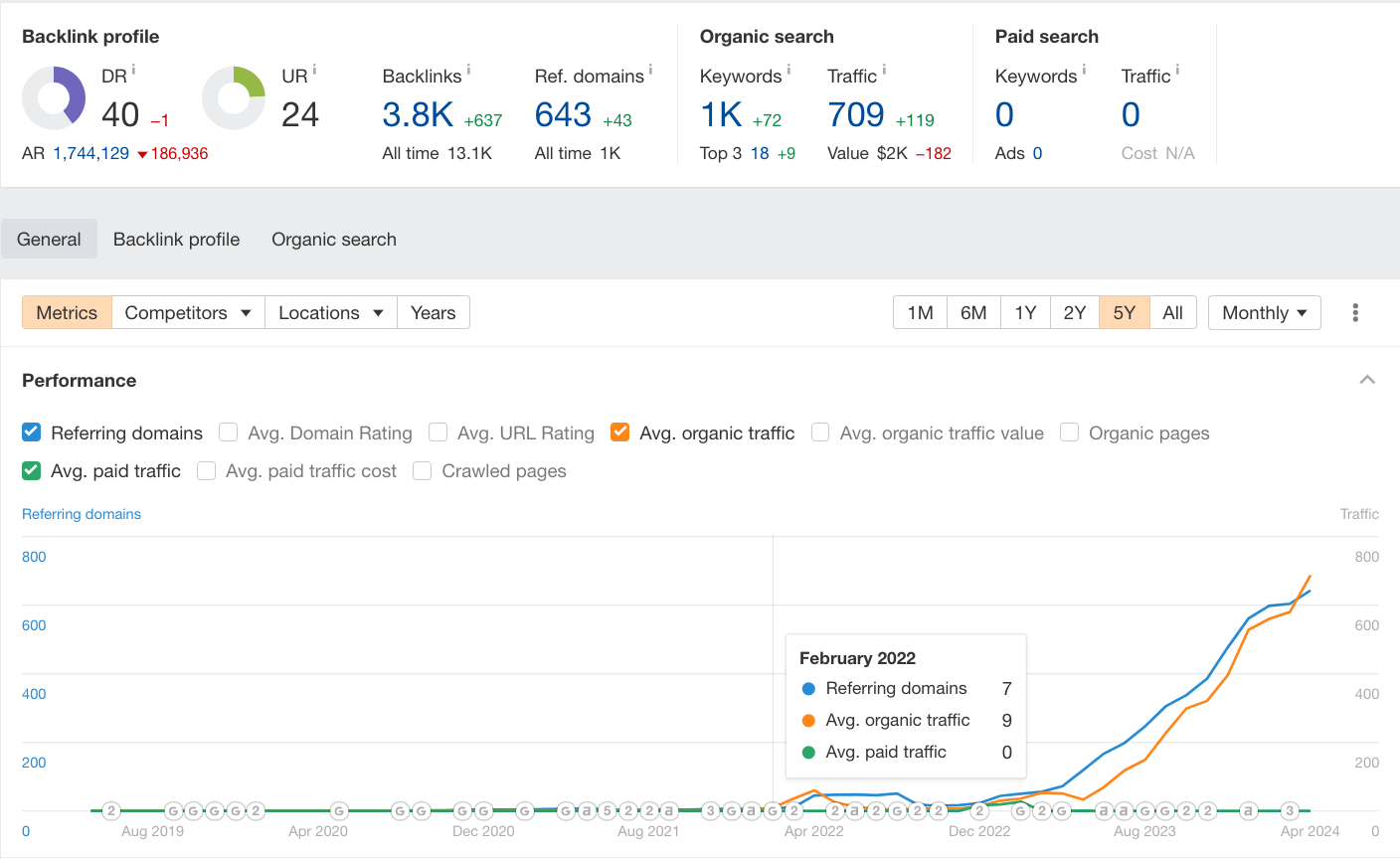
Between project completion in January 2022 and April 2024 — a 27-month window — Merchynt’s organic traffic grew approximately 6,800%. That is a number that needs context to be useful: it is large because the starting baseline was small. Compounding 27 months of organic growth on a site that was substantially under-monetised at the start produces dramatic-looking percentages.
What the percentage actually represents is sustained organic growth across a category cluster — Merchynt is now ranking on page 1 of Google for GBP management service, white label reputation management, local SEO outsourcing, white label review management, and several other adjacent commercial queries. Each of those rankings represents recurring qualified traffic from buyers actively in market for what Merchynt sells.
The compounding effect on the business — beyond traffic — is the agency-side credibility that comes with category visibility. Agencies looking for white-label local SEO partners almost always start with a search. Being the page-1 answer for the relevant queries is the difference between being on the consideration shortlist and not being known at all.
Why this kind of work matters
SaaS SEO has a few specific failure modes. The most common is treating the company blog as a content marketing exercise disconnected from commercial query targeting. The second is over-investing in product-feature pages while under-investing in the use-case and category pages that buyers actually search for. The third is ignoring the white-label or partner audience entirely when it is often the most efficient acquisition channel for the category.
The Merchynt programme worked because the on-page rebuild was aligned with how the actual buyer searches, not with how an internal product team thinks about the product. That alignment is the work.
If you run a B2B SaaS business that has a strong product but underwhelming organic visibility, the same playbook is portable. Get in touch and we can run a quick category-query audit to show you where the gaps are.