
E-commerce SEO in Singapore has three structural challenges generic SEO providers consistently mishandle: category architecture at scale, faceted navigation that doesn’t waste crawl budget, and product feed quality that feeds both organic Shopping visibility and traditional rankings. Platform choice (Shopify, WooCommerce, Magento, custom) adds another layer of complexity — each has different SEO ceilings and different optimisation patterns.
This guide covers what actually works for Singapore e-commerce SEO, how platform choice affects your SEO ceiling, and the specific work streams that drive organic revenue rather than just organic traffic.
Why E-commerce SEO Is Structurally Different
E-commerce SEO operates on challenges that don’t exist for service businesses or content sites:
Scale. A service business might have 30 pages. A Singapore e-commerce store might have 5,000–50,000+ product pages. Optimisation patterns must work at scale through templates and rules, not through manual per-page work.
Faceted navigation. Filter combinations (size × colour × brand × price) create exponential URL proliferation. Done wrong, this destroys crawl budget and creates massive duplicate content. Done right, it captures substantial long-tail commercial traffic.
SERP feature dominance. Google Shopping carousels, image carousels, and product knowledge panels increasingly dominate transactional SERPs above traditional organic results.
Inventory dynamics. Products go out of stock, get discontinued, come back in new variants. Each transition creates SEO consequences.
Conversion happens in the SERP. Google Shopping and reviews often allow purchase consideration before users ever visit your site. Your product presence in the SERP matters almost as much as your site.
Generic SEO playbooks applied to e-commerce without accounting for these dynamics produce mediocre outcomes. Singapore e-commerce stores need platform-aware, scale-aware SEO.
Platform Comparison — Shopify vs WooCommerce vs Custom for SG E-commerce
Platform choice substantially affects your SEO ceiling. Honest comparison:

Shopify (and Shopify Plus)
Strengths:
– Strong out-of-box SEO foundation — clean URLs, fast hosting, mobile-responsive themes
– Excellent Google Shopping integration
– Mature app ecosystem for SEO extensions
– Reliable uptime and security
– Simple to manage for non-technical teams
Weaknesses:
– URL structure limitations (forced /collections/, /products/ patterns)
– Some technical SEO work (robots.txt edits, advanced canonicalisation) is constrained
– Collection/category page SEO ceiling is genuinely lower than custom
– App costs can add up for complex SEO needs
– Shopify’s SEO ceiling is the platform’s ceiling, not your ceiling
Best for: Small to mid-sized SG e-commerce (SGD 500K-20M revenue) where platform convenience outweighs SEO limitations. Most Singapore DTC brands fit here.
WooCommerce
Strengths:
– Full technical flexibility — any URL structure, any technical SEO pattern
– Integrates with WordPress content capabilities for hybrid blog + commerce
– Lower per-transaction costs at scale
– Extensive plugin ecosystem
– Full control over hosting, performance, customisation
Weaknesses:
– Requires technical capability (you or a dev partner)
– Performance optimisation is on you — WordPress + WooCommerce can be slow if not properly configured
– More maintenance overhead (updates, security, backups)
– Plugin sprawl can create performance and security issues
Best for: SG e-commerce businesses with some technical capability or dev partnership, content-heavy commerce (blog + store), or stores wanting maximum SEO flexibility.
Magento (Adobe Commerce)
Strengths:
– Enterprise-grade capability
– Excellent for complex catalogues (B2B, multi-warehouse, multi-currency)
– Powerful native functionality
– Strong multi-site/multi-store architecture
Weaknesses:
– Expensive (licence + hosting + development)
– Requires significant technical resources
– Overkill for most SMB e-commerce
– Slower development cycles
Best for: Enterprise SG e-commerce (SGD 20M+ revenue), complex B2B, or businesses with dedicated dev teams.
Headless / Custom
Strengths:
– Maximum performance (Next.js frontend + Shopify/BigCommerce/custom backend)
– Best mobile Core Web Vitals
– Full flexibility for both commerce and content
– Best technical SEO ceiling
Weaknesses:
– High upfront cost (SGD 80K-300K+ for serious headless builds)
– Ongoing engineering capability required
– Complexity for content editors
– Overkill for most stores
Best for: High-revenue SG e-commerce where performance and flexibility justify the investment, or brands with engineering teams and specific technical requirements.
Other Platforms
BigCommerce — solid middle ground between Shopify and enterprise custom. Less dominant in SG market.
Squarespace Commerce / Wix Commerce — suitable for micro stores; SEO ceiling is genuinely limited.
Shopify Plus — Shopify’s enterprise tier. Adds capabilities, removes some limits; still fundamentally Shopify.
What E-commerce SEO Services Actually Cover
Genuine e-commerce SEO engagement includes:
1. Comprehensive E-commerce SEO Audit
Full diagnostic across:
- Site architecture and category taxonomy
- Faceted navigation handling (indexable vs blocked vs canonicalised)
- Category page optimisation
- Product page template SEO
- Google Shopping feed quality
- Internal search functionality
- Review and UGC infrastructure
- Out-of-stock and discontinued product handling
- International handling (for multi-market stores)
- Mobile experience
- Core Web Vitals at template level
- Schema implementation (Product, Review, BreadcrumbList, Organization)
- Backlink profile
- Competitive landscape
2. Category Page Optimisation
Category pages typically drive the largest organic revenue in e-commerce. Optimisation covers:
- Above-fold positioning content (most templates lack this)
- URL and breadcrumb structure
- Faceted navigation strategy per facet
- Internal linking architecture
- Supporting content below the grid (buyer’s guides, comparison content)
- Schema implementation
- Conversion-path optimisation
3. Product Page Optimisation at Scale
For stores with hundreds or thousands of SKUs, product work operates through templates:
- Title pattern templates
- Description pattern templates
- Schema (Product, Review, AggregateRating) at template level
- Image optimisation patterns
- Related product surfacing
- Review collection and display
4. Faceted Navigation Engineering
The highest-impact technical work in most e-commerce SEO:
- Audit existing facet combinations
- Strategic decisions per facet (indexable, noindex, blocked)
- Canonical strategy
- URL parameter handling
- Sitemap segmentation for indexable filters
Done well, can unlock 30-50% organic traffic gains by capturing previously invisible long-tail commercial traffic.
5. Google Shopping Strategy
- Merchant Center setup and policy compliance
- Product feed quality optimisation
- Feed-to-schema alignment
- Free Shopping listings optimisation
- Paid Shopping campaign foundation where strategic
6. Review and UGC Strategy
- Review acquisition workflows
- Review schema implementation
- Review response training
- User-generated content (Q&A, customer photos) as both UX and SEO asset
7. Inventory-Aware SEO Handling
Strategic handling of out-of-stock, discontinued, and seasonal products to maintain SEO value without accumulating junk.
8. International E-commerce (for multi-market stores)
For stores selling into Malaysia, Indonesia, Thailand, or broader APAC alongside Singapore: hreflang strategy, multi-currency handling, market-specific catalogue management, regional Shopping feeds.
See our International SEO Services for full multi-market methodology.
Singapore-Specific E-commerce SEO Considerations
Mobile-first commerce. Singapore’s mobile commerce share is particularly high. Mobile Core Web Vitals and mobile checkout optimisation matter enormously.

Regional expansion patterns. Many Singapore e-commerce brands expand to Malaysia, Indonesia, and broader APAC. Architecture decisions should anticipate this.
Multilingual considerations. For certain categories (beauty, food, lifestyle), meaningful search volume exists in Mandarin and sometimes Malay. Worth considering multilingual content strategy.
Local delivery integration. SingPost, Ninja Van, Qxpress integrations affect both UX and structured data (delivery schema).
GST handling. Proper tax display in product pages and schema matters for both compliance and clarity.
E-commerce SEO Pricing in Singapore
Realistic pricing for e-commerce SEO services:
- Small stores (under 500 SKUs): SGD 2,500–5,000/month retainers
- Mid-sized stores (500-5,000 SKUs): SGD 4,500–10,000/month
- Large stores (5,000-50,000 SKUs): SGD 8,000–20,000/month
- Enterprise stores (50,000+ SKUs, multi-market): SGD 15,000–40,000+/month
One-off audits for e-commerce stores range SGD 5,000–25,000 depending on catalogue size and complexity.
See our complete SEO pricing guide for Singapore for broader context.
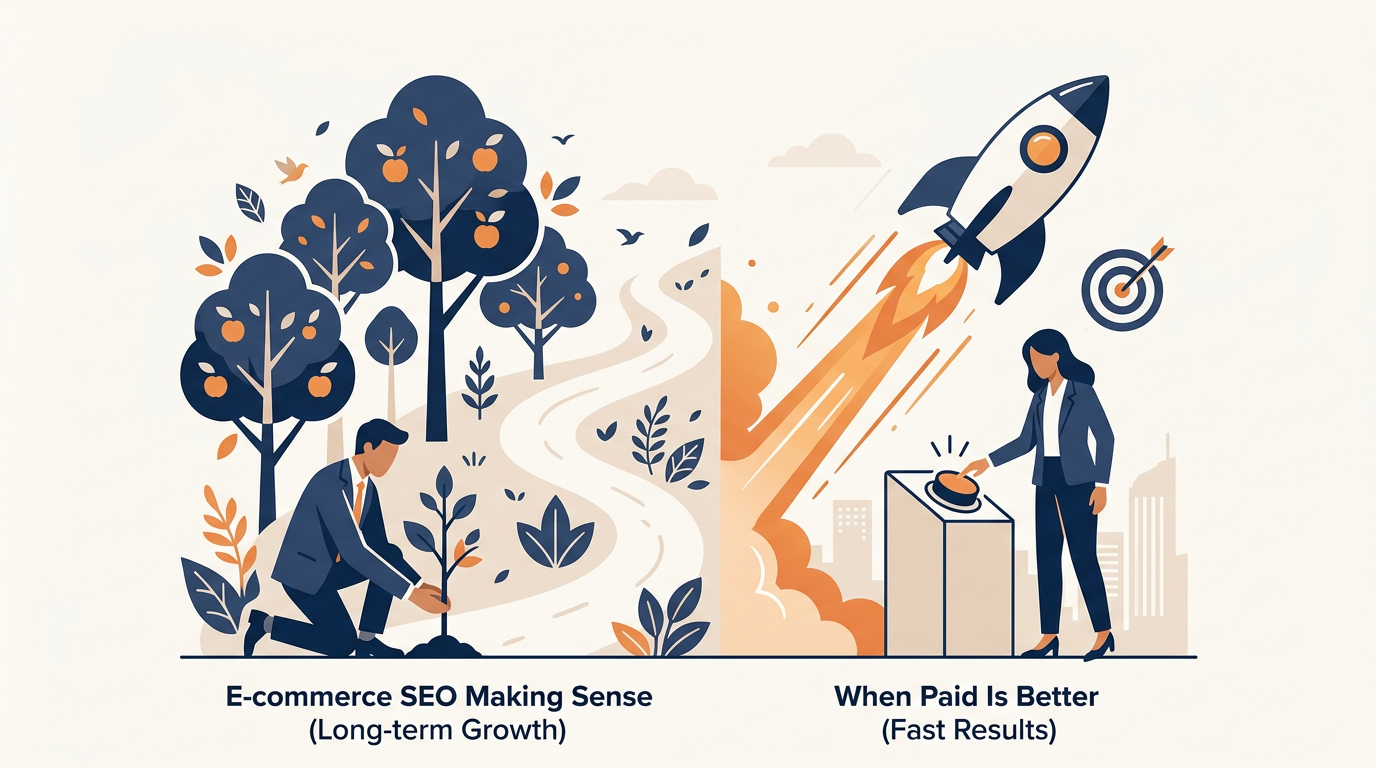
When E-commerce SEO Makes Sense (and When Paid Is Better)
E-commerce SEO investment is worth making when:
- You’re in a category where shoppers research before buying (fashion, electronics, beauty)
- Your competitors are ranking for commercial keywords you want
- You have sufficient catalogue size to justify category-page strategies
- Your time horizon is 12+ months (SEO compounds slowly)
- You’ve validated product-market fit and are scaling
E-commerce SEO is less useful when:
- You’re pre-product-market-fit
- Your products are entirely impulse-driven (minimal research behaviour)
- Your budget forces choosing one channel and short-term paid has better ROI
- You’re in extremely competitive categories with limited differentiation
Most SG e-commerce businesses benefit from paid + SEO in parallel — paid for short-term revenue, SEO for long-term compounding visibility.
FAQ — E-commerce SEO Services Singapore
How much does e-commerce SEO cost in Singapore?
Retainers range SGD 2,500-40,000+/month depending on store size and complexity. Small stores may fit SGD 3,000-5,000/month programmes; enterprise stores often require SGD 15,000+.
Which platform is best for SEO — Shopify, WooCommerce, or custom?
Depends on business size and technical capability. Shopify suits most SMB DTC. WooCommerce provides more flexibility for technical teams. Custom/headless for high-revenue stores needing maximum performance.
Can I do e-commerce SEO myself?
Basic on-page and product optimisation, yes. Faceted navigation strategy, category architecture at scale, Google Shopping feed optimisation, and international SEO typically require specialist expertise.
How long does e-commerce SEO take to drive revenue?
Local traffic improvements in 2-4 months. Category page rankings in 6-12 months. Category authority in 12-24 months. Commercial revenue impact compounds with rankings.
How is Shopify SEO limited compared to custom?
Fixed URL structures, constrained technical SEO configurations (robots.txt, advanced canonicalisation), and platform-level Core Web Vitals ceilings. Most limits are non-blocking for SMB stores.
Do I need a different SEO agency for e-commerce vs service business?
Specialist e-commerce SEO knowledge meaningfully affects outcomes for serious stores. Generalist SEO agencies often mishandle faceted navigation, product feed, and category architecture work.
What’s the biggest e-commerce SEO mistake in Singapore?
Under-investing in category page optimisation. Most SG e-commerce stores have sparse, templated category pages missing the content and internal linking that drive category-level rankings.
Discuss Your E-commerce SEO
If you run a Singapore e-commerce store and want an honest evaluation of your current SEO position and specific revenue opportunities, reach out.

Book a free 30-minute consultation or email [email protected].
Related Reading
- E-commerce SEO Services — full service methodology
- Technical SEO Services — for technical foundations
- International SEO Services — for multi-market stores
- Complete Guide to SEO in Singapore — pillar overview
- How Much Does SEO Cost in Singapore? — pricing context