
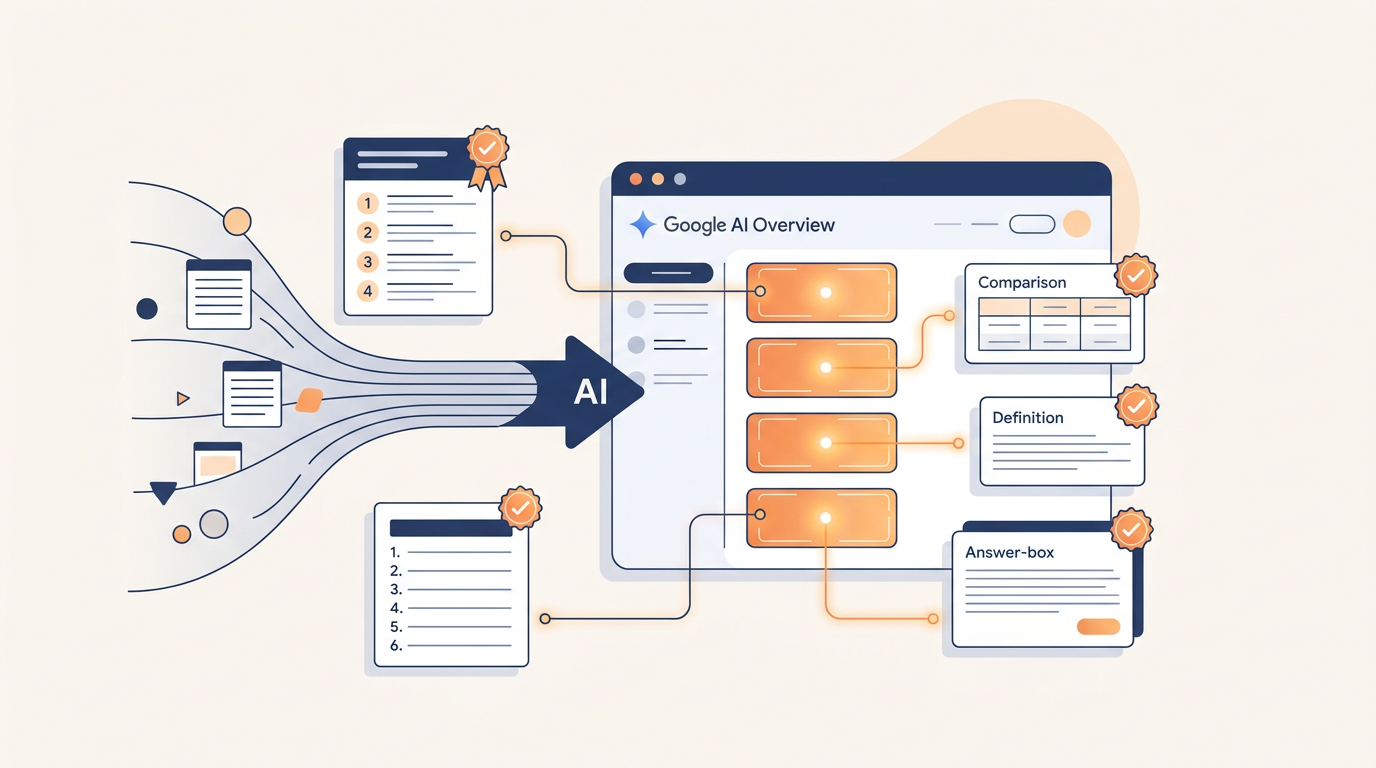
Google AI Overviews — the AI-generated answer summaries appearing at the top of search results — now appear on 15-30% of queries depending on category. Where they appear, traditional organic results sit below them, often below the fold. Being cited in the AI Overview itself has become a distinct ranking objective, with specific patterns that differ from traditional SEO.
This guide covers exactly how to optimise content to be cited by Google AI Overviews — the structural patterns that work, the EEAT signals that matter, how to measure performance, and what to realistically expect.
How AI Overviews Actually Work
AI Overviews use a retrieval-augmented generation approach: Google’s AI system identifies high-quality sources from its index, reads relevant content, and synthesises an answer. The sources it selects get cited in the Overview with visible attribution and link-outs.
Critical observations from sampling behaviour:
AI Overviews lean heavily on page 1 rankings. Content selected for citation is overwhelmingly from traditional top-ranking results. Strong traditional SEO remains the primary path to AI Overview citation.
Structural patterns matter. Content optimised with specific question-answer structures, definition-first patterns, and factual density gets cited preferentially.
Authority signals compound. Sites with strong EEAT signals (author credentials, external authority, Organization schema) are selected more frequently than otherwise-equivalent sites with weaker authority.
Fresh content helps. AI Overviews often favour recently-published content for timely topics, though evergreen high-quality content remains strongly represented.
The Content Patterns That Earn AI Overview Citations
Specific structural patterns consistently observed in cited content:
Question-Format Headers
Content with H2/H3 headers phrased as natural questions gets cited more than content with topic-labelled headers.
Less cited: “Common SEO Mistakes”
More cited: “What Are the Most Common SEO Mistakes to Avoid?”
Align header framing with how users actually ask the question.
Definition-First Opening Paragraphs
After each question-format header, lead the first paragraph with a direct, concise answer. AI often cites these opening paragraphs verbatim.
Less effective: “Before getting into the main SEO mistakes, let’s understand why SEO mistakes happen. Many businesses…”
More effective: “The most common SEO mistakes are: (1) targeting keywords without search intent alignment, (2) creating content without topical authority foundations, (3) neglecting Core Web Vitals. Each compounds damage over time.”
Lead with the direct answer. Elaboration can follow.
Factual Density
AI engines cite content with specific, verifiable facts over content with vague generalities.
Less cited: “SEO pricing varies significantly across the market.”
More cited: “SEO pricing in Singapore ranges from SGD 1,500 per month for basic local SEO to SGD 25,000 per month for enterprise programmes. Mid-market SMBs typically invest SGD 4,000-10,000 monthly.”
Concrete numbers, specific claims, verifiable details.
Source Attribution
Counter-intuitively, citing authoritative external sources increases your own citation likelihood. Content that cites others signals editorial rigour.
Include relevant external citations — Google Search Central guidance, industry reports, research studies.
Structured Comparison and Lists
AI engines readily cite content with clear comparison tables and structured lists. These formats are extractable in ways that flowing paragraphs aren’t.
Use tables for comparisons, numbered lists for sequences, bullet points for options.
FAQ Sections with Schema
Dedicated FAQ sections with FAQ schema markup get cited frequently. The structured question-answer format makes extraction clean.
Every content piece with multiple sub-questions benefits from a consolidated FAQ section with schema.
Entity Clarity
Explicit naming of entities (products, concepts, people, places) helps AI engines map relationships.
Name things specifically. Link entities to canonical references (Wikipedia, Wikidata, official sources where relevant).
EEAT Signals That Matter for AI Overviews
Author Credentials
AI Overviews for YMYL topics preferentially cite content from authors with verifiable credentials.
- Author bylines on every piece
- Author profile pages with credentials, training, experience
- Person schema linking authors to credential verification
- External author authority signals (publications, speaking, professional affiliations)
Organization Entity
Strong Organization schema with sameAs property linking to authoritative profiles signals business legitimacy.
- Crunchbase, LinkedIn company page
- Industry associations
- Wikipedia/Wikidata (where genuinely warranted)
External Authority
Sites cited by authoritative publications appear more frequently in AI Overviews.
- Digital PR producing editorial coverage. See Digital PR Singapore.
- Industry publication presence
- Conference speaking, podcast appearances
- Expert quoting in mainstream press
Content Depth and Substantive Perspective
AI systems consistently cite content demonstrating depth and original perspective over generic overview content.
Avoid generic “introduction to X” content hoping to rank. Create substantive content with clear expert perspective.
Schema and Structured Data for AI Overviews
Structured data helping AI extraction:

- FAQ schema — question/answer pairs clearly extractable
- HowTo schema — step-by-step content
- Article schema — author attribution, dates, section
- Person schema — author identity with sameAs
- Organization schema — business identity
- BreadcrumbList schema — content hierarchy context
- DefinedTerm schema — glossary content
Implement comprehensively across priority content. See Technical SEO Audit Singapore for schema audit methodology.
How to Measure AI Overview Performance
Measurement remains genuinely challenging in 2026:
Manual Sampling (Primary Method)
Query priority target keywords across Google (in private/incognito mode to reduce personalisation effects). Record:
- Does an AI Overview appear?
- Is your content cited?
- What position among citations (first, middle, last)?
- What context surrounds your citation?
- Which competitors are cited?
Sample monthly across 20-50 priority queries to build trend data.
Specialist Tools
Emerging tools track AI Overview visibility at scale:
– SE Ranking AI Overview Tracker
– Some Ahrefs and Semrush features
– Specialist AI visibility platforms (still early-stage)
Tool coverage is incomplete but improving.
Proxy Metrics
Indirect signals that often correlate with AI Overview performance:
– Impressions on featured-snippet-eligible queries
– Pages with strong schema implementation
– Content with high EEAT signals
– Page 1 rankings (necessary but not sufficient for AI Overview citation)
Realistic Expectations for AI Overview Optimisation
Honest framing:

AI Overviews are additive, not replacement. Most queries still return traditional results. Even queries with AI Overviews still show traditional results below. Traditional SEO remains primary; AI Overview optimisation is additional.
Citation doesn’t always drive clicks. Sometimes AI Overview citation produces brand impression without click — still valuable, but differently valuable than traditional rankings.
Measurement is immature. Accept that you won’t have complete measurement. Manual sampling + proxy metrics is current best practice.
Patterns continue to evolve. What works in Q1 2026 may not work in Q4 2026. AI systems iterate; patterns shift. Stay current.
Integration with broader SEO matters more than isolated AEO tactics. Strong fundamental SEO + AI Overview-specific optimisation produces better results than AI Overview tactics applied to a weak foundation.
For the broader strategic context, see our AEO Services page and What Is AEO? guide.
Common AI Overview Optimisation Mistakes
Treating AEO as separate discipline from SEO. The foundation is traditional SEO. Strong rankings are near-prerequisite for AI Overview citation.
Over-emphasising schema alone. Schema helps but isn’t sufficient. Content quality, authority, structure all matter.
Optimising for AI at expense of users. Content stuffed with question-format headers and definition-first paragraphs just to game AI can damage UX. Balance.
Ignoring measurement. Even imperfect measurement produces learning. “We’ll just do good SEO” without AEO-specific tracking misses patterns worth acting on.
Shipping AI content at scale. AI-generated content is increasingly the least likely to be cited by AI Overviews. The irony is structural — AI systems can detect AI content.
FAQ — AI Overviews Optimization
How do I rank in Google AI Overviews?
Strong traditional SEO rankings + specific structural patterns (question-format headers, definition-first paragraphs, factual density, FAQ schema, clear source attribution) + strong EEAT signals.

What percentage of queries show AI Overviews?
Currently 15-30% depending on category. Higher for informational queries, lower for transactional. Expected to continue expanding.
Can you guarantee AI Overview citation?
No. AI selection isn’t deterministic. Good practices increase probability; they don’t guarantee outcomes.
How do AI Overviews affect my organic traffic?
Mixed impact. Queries with AI Overviews may show lower click-through to traditional results. Citation in the AI Overview itself can drive brand awareness and selective clicks.
Should I optimise for AI Overviews at the expense of traditional SEO?
No. Traditional SEO remains primary. AI Overview optimisation is additive. Treat them as complementary.
What content types get cited most in AI Overviews?
Substantive content with clear structure, factual depth, authority signals, and expert perspective. Generic overview content is rarely cited.
Do I need separate AEO services or can my SEO agency handle AI Overviews?
Most competent senior SEO providers in 2026 should integrate AI Overview optimisation. Separate AEO-only services usually make sense only for very large programmes.
How often should I check my AI Overview citations?
Monthly sampling for priority queries. AI systems iterate faster than traditional search; frequent monitoring is necessary.
Discuss AI Overview Strategy
If you want to build AI Overview optimisation into your Singapore SEO programme, reach out for a substantive conversation about strategy.
Book a free 30-minute consultation or email [email protected].
Related Reading
- AEO Services — full methodology
- What Is AEO? Answer Engine Optimisation Explained — broader context
- AEO Agency — what AEO services deliver
- GEO Services — generative engine optimisation
- Complete Guide to SEO in Singapore — pillar overview
- Technical SEO Audit Singapore — schema implementation